

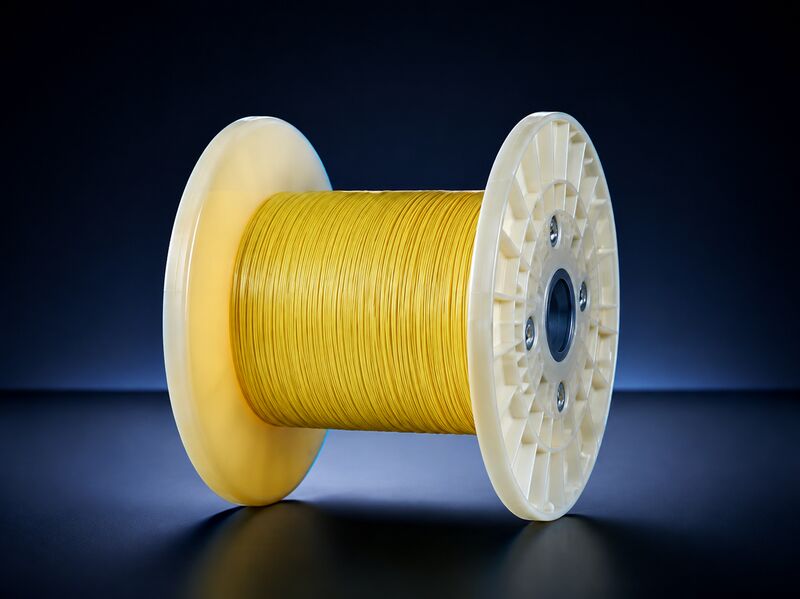
KFRP
Technical characteristics of KFRP(Kevlar fiber reinforced plastic) reinforcement:
1. KFRP fiber optic cable reinforcement core overcomes the shortcomings of traditional metal fiber optic cable reinforcement components, with excellent advantages such as corrosion resistance, lightning resistance, electromagnetic field interference resistance, and high tensile strength.
2. KFRP fiber optic cables have stronger core flexibility, are less prone to breakage, and can better protect optical fibers. They are particularly suitable for direct introduction from outdoors into indoor environments and are widely used in introduction networks and indoor wiring applications.
FRP/QFRP/KFRP non-metallic optical cable reinforcement core is a high-performance non-metallic optical cable reinforcement component, which has the characteristics of low density, high strength, low expansion, impact resistance, fracture resistance, soft texture, easy bending, and insensitivity to electric shock
Compared to conventional phosphated steel wire reinforced components, FRP non-metallic optical cable reinforced cores have multiple differentiated advantages:
1. Stronger corrosion resistance. Phosphated steel wire is a metal material that is prone to rusting and corrosion in wet, saline alkali, and humid environments, shortening the service life of optical cables; FRP non-metallic material, resistant to acid, alkali, and water vapor erosion, suitable for complex outdoor installation scenarios.
2. Insulation is non-conductive and has high safety. Phosphated steel wire is a conductor that is prone to conducting current and damaging communication equipment when struck by lightning; FRP itself is insulated, blocking the conductive path and improving the lightning protection safety performance of the line.
3. Anti electromagnetic interference, more stable signal. Metal steel wire is susceptible to electromagnetic interference caused by the magnetic field of surrounding power cables; FRP has no electromagnetic induction and is not affected by external electromagnetic fields, ensuring continuous and stable transmission of optical communication signals.
4. Lightweight and lightweight, making construction more convenient. Under the same strength conditions, the self weight of FRP is much lower than that of phosphated steel wire,
Product Parameters:
| No. | Item | Unit | Specification Requirements |
| 1 | Diameter Deviationa Body | mm | ±0.05 |
| Coating | |||
| 2 | Out-of-Roundness Body | % | ≤5.0 |
| Coating | |||
| 3 | Minimum Bending Performance | — | Bending radius 10D, surface free of cracks or burrs, no kinks, no disintegration, and smooth to the touch |
| 4 | Tensile Strength | MPa | ≥1600 |
| 5 | Tensile Modulus of Elasticity | GPa | ≥52 |
| 6 | High-Temperature Bending Performance (80℃, 24 h) | — | Bending radius 30D, surface free of cracks or burrs, no kinks, no disintegration, and smooth to the touch |
| 7 | Low-Temperature Bending Performance (-40℃, 24 h) | — | Bending radius 30D, surface free of cracks or burrs, no kinks, no disintegration, and smooth to the touch |
| Note 1: D represents the nominal body diameter of KFRP. | |||
| Note 2: The bending life of the material is to be studied. | |||
| a For finished KFRP products with coating, only the diameter deviation and out-of-roundness of the coating are considered; the diameter deviation and out-of-roundness of the body do not need to be considered. | |||